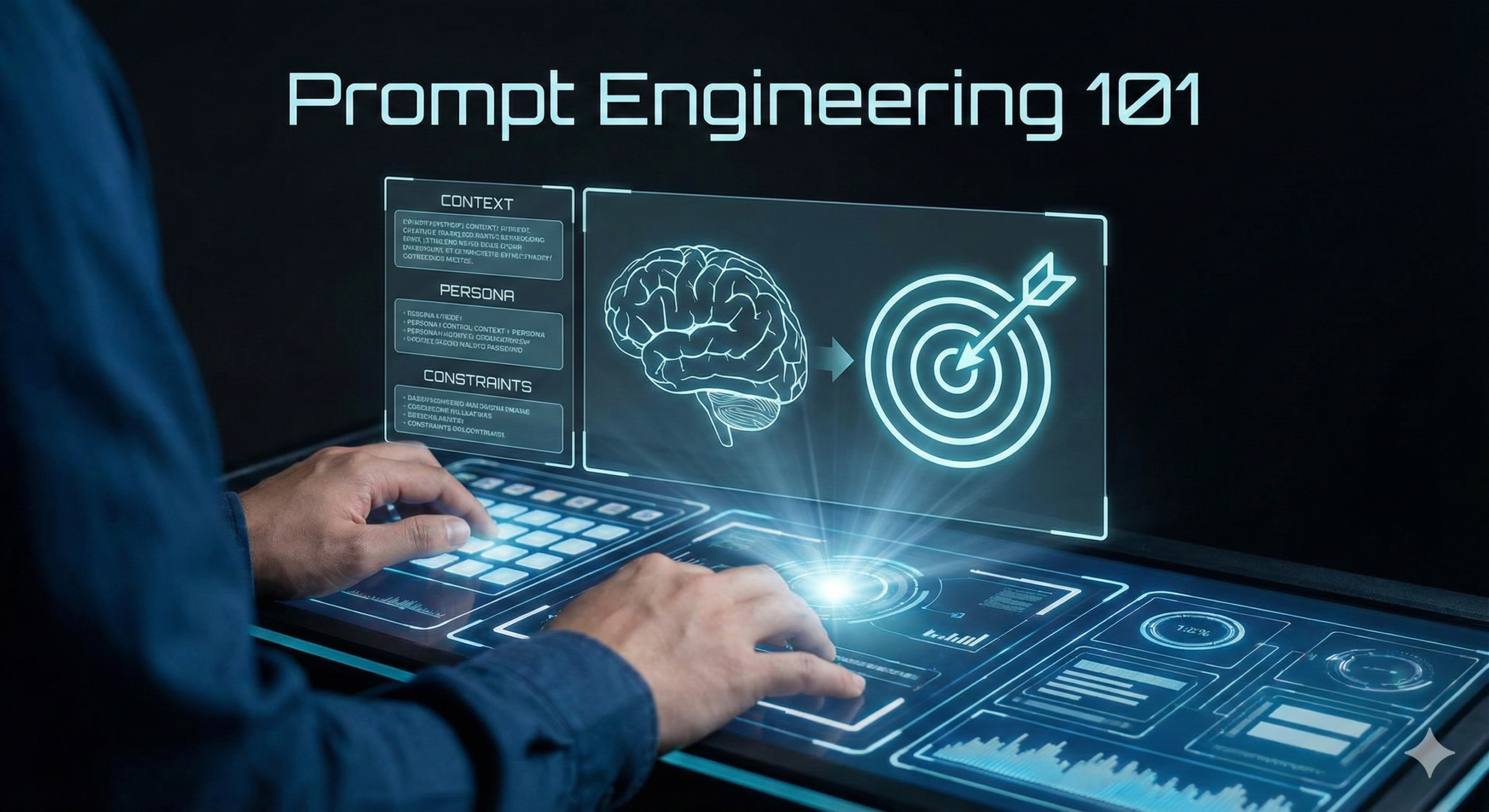
The era of simple “chatting” with artificial intelligence has evolved into a sophisticated discipline where precision is the ultimate currency. In 2026, the difference between a mediocre response and a game-changing output lies entirely in how you structure your request. Mastering Prompt Engineering 101 is no longer a niche skill for developers; it is the fundamental literacy required to navigate a world powered by Large Language Models (LLMs). This guide will provide you with the blueprint to transform vague ideas into high-fidelity AI results every single time.
What is Prompt Engineering?
At its core, prompt engineering is the process of refining inputs to pull the most accurate, relevant, and creative responses from an AI. Think of the AI as a brilliant intern who has read every book in the world but lacks any specific context about your current needs. Without clear instructions, the “trash in, trash out” principle applies.
By applying the principles of Prompt Engineering 101, you are effectively building a bridge between human intent and machine execution. It involves understanding the underlying logic of models like GPT-5 or Claude 4 to ensure your instructions are interpreted without ambiguity. Whether you are generating code, writing legal briefs, or designing marketing strategies, the structure of your prompt determines the quality of your career.
The Core Framework: The Anatomy of a Perfect Prompt
To get exactly what you want, you must move beyond one-sentence commands. A professional-grade prompt typically consists of four pillars: Context, Persona, Task, and Constraints. This structured approach is the foundation of Prompt Engineering 101.
1. Assign a Persona
Start by telling the AI who it should be. If you need a Python script, tell it to “act as a Senior Full-Stack Developer.” If you need an SEO article, tell it to “act as a veteran Content Strategist.” Assigning a persona narrow-casts the AI’s internal database to a specific expertise level.
2. Provide Deep Context
Context is the “why” and the “who” of your request. Instead of asking for a “workout plan,” explain that you are a “30-year-old developer with a history of back pain looking for a 20-minute home routine.” Context eliminates the AI’s need to guess your intentions.
3. Define the Task Clearly
Use strong action verbs. Phrases like “Analyze,” “Synthesize,” “Draft,” or “Debug” are much more effective than “Write something about…” Be specific about the desired output format, whether it is a table, a list of bullet points, or raw JSON code.
4. Set Strict Constraints
Constraints are often more important than the instructions themselves. Specify word counts, tone of voice, or things to avoid. For example: “Write this for a non-technical audience and do not use industry jargon like ‘latency’ or ‘throughput’.”
Advanced Techniques in Prompt Engineering 101
Once you master the basics, you can move into advanced strategies that professional engineers use to maximize model performance. Understanding these distinctions is a key part of your Prompt Engineering 101 journey.
Zero-Shot vs. Few-Shot Prompting
In many cases, the AI needs to see what “good” looks like. Providing examples within your prompt—known as “Few-Shot Prompting”—drastically increases the likelihood of getting the right format on the first try.
| Technique | Description | Best For |
| Zero-Shot | Providing a prompt with no examples. | Simple tasks or creative brainstorming. |
| Few-Shot | Providing 2-3 examples of the desired input/output. | Pattern matching, specific formatting, or coding styles. |
| Chain of Thought | Asking the AI to “think step-by-step.” | Complex logic, math, or troubleshooting. |
The “Think Step-by-Step” Miracle
One of the most effective hacks in Prompt Engineering 101 is the “Chain of Thought” (CoT) technique. By simply adding the phrase “Let’s think through this step-by-step,” you force the model to lay out its reasoning before giving the final answer. This reduces hallucinations and improves accuracy in logical tasks like coding or financial analysis.
Real-World Example: From Basic to Pro
Let’s look at how Prompt Engineering 101 transforms a mediocre prompt into a high-value asset.
The Basic Prompt:
“Write a blog post about SEO for my website.”
The Pro Prompt (Applying Prompt Engineering 101):
“Act as a Senior SEO Specialist. I need a 1,000-word blog post for a tech startup called ‘DevFlow’ that targets junior developers. The topic is ‘Why Clean Code is Essential for Technical SEO.’ Use a helpful, professional tone. Include a comparison table between minified and unminified JS. Ensure the conclusion has a call-to-action to download our free debugger tool. Do not use generic introductions; start with a surprising statistic about site speed.”
The difference in output quality between these two prompts is night and day. The second prompt provides a clear roadmap, leaving no room for the AI to drift off-topic.
Common Pitfalls to Avoid
Even those who have studied Prompt Engineering 101 often fall into traps that lead to suboptimal results.
- Ambiguity: Avoid words like “some,” “better,” or “fast.” Use quantifiable metrics instead.
- Prompt Stuffing: Don’t give 20 different tasks in one prompt. Break complex projects into a “prompt chain” where the output of one step becomes the input for the next.
- Neglecting the Feedback Loop: AI is iterative. If the first result isn’t perfect, don’t start over. Say: “The tone is good, but make the second paragraph more concise and expand on the technical details of the API.”
Pros and Cons of Manual Prompting
| Pros | Cons |
| High level of creative control | Time-consuming for large-scale tasks |
| No technical setup required | Requires constant practice to stay updated |
| Immediate results for custom needs | Dependent on human clarity |
Why You Should Master Prompt Engineering 101 Now
As AI agents become more autonomous, the “prompt” is transitioning into a set of “parameters” or “policies.” However, the logic remains the same. Learning Prompt Engineering 101 teaches you how to think logically and communicate with high precision—skills that are transferable to managing human teams and complex software architectures.
According to research from OpenAI’s Documentation, structured prompting can improve model performance by up to 40% in specialized tasks. For developers and content creators, this efficiency gain is the difference between working 40 hours a week or 20.
Conclusion
Mastering Prompt Engineering 101 is the secret to unlocking the full potential of the AI revolution. By treating your prompts as structured data rather than casual conversation, you gain a massive competitive advantage. Remember to assign a persona, provide rich context, define clear tasks, and use iterative feedback to refine your results.
As you continue to experiment, you will find that the AI is only as limited as the instructions you provide. Start applying these frameworks today, and you will see an immediate leap in the quality, accuracy, and creativity of your AI-generated work.